Kansas Elections 2026: What the Latino Community Needs to Know Before Voting

Kansas | October 11, 2026
By Claudia Amaro | Planeta Venus

Her son is about to turn 21.
For years, a Kansas mother, whom Planeta Venus is keeping anonymous at her request, has devoted much of her life to caring for him and helping him become more independent. He has Down syndrome. Although he can do some things on his own, she says he still needs daily support.
Then the notices arrived.
According to his mother, the letters announced that benefits and services the family relied on, including health coverage, financial assistance, and caregiving support, would end in about two weeks. She understood the explanation to mean that her son had been classified as sufficiently independent to no longer qualify for those supports.
But that did not reflect the needs she still met every day.
Her son had become more independent. He still needed help. For his mother, both things were true.
Her account raises a question that deserves attention during an election: How do public institutions decide who qualifies for assistance, and what happens when a family believes those decisions do not reflect their reality?
It also reminds us why the entire ballot matters. No single elected official controls every benefit decision. But elections determine who writes laws, approves budgets, oversees agencies, and represents families when public systems fail them.
On Tuesday, November 3, Kansas voters will choose a governor, a U.S. senator, all four members of the state’s congressional delegation, statewide executive officers, and all 125 members of the Kansas House. Depending on where they live, voters will also see State Board of Education races, judicial questions, local contests, and state Senate special elections. A proposed constitutional amendment concerning citizenship and voting will appear statewide.
For Latino families, these decisions intersect with immigration enforcement, college affordability, health coverage, food assistance, education, and access to the ballot.
Latinos accounted for approximately 14.2% of Kansas’ population and 9.4% of its eligible electorate in 2024, according to Census-based analyses by USAFacts and Pew Research Center. That means nearly one in ten eligible Kansas voters is Latino—not necessarily one in ten registered voters or people who ultimately cast a ballot.
Planeta Venus does not endorse candidates or parties. This guide explains selected issues, identifies candidates, and helps readers prepare to vote informed.
Immigration enforcement and local police
The U.S. Attorney’s Office said ICE made 104 arrests during an operation in southwest Kansas from September 22 through September 24. Officials in Dodge City, Garden City, and Liberal said they had not received advance notice.
The operation disrupted daily life beyond the people arrested. Liberal Vice Mayor Janeth Vazquez said 120 students missed school at Meadowlark Elementary. U.S. citizens interviewed by KCUR also described stops they believed amounted to racial profiling. Those accounts should be understood as reported experiences and allegations, not court findings.
Livestock groups reported processing disruptions and delayed cattle shipments. Reuters cited USDA estimates showing that U.S. cattle slaughter fell 16% on Thursday and 14% on Friday compared with the corresponding days a week earlier. Those were national figures—not a measurement of beef production exclusively in southwest Kansas.
Kansas lawmakers also enacted HB 2372 over Governor Laura Kelly’s veto. The law allows county sheriffs to enter certain immigration-enforcement agreements without county-commission approval. These agreements, commonly called 287(g) agreements, authorize participating local officers to perform specified federal immigration-enforcement functions.
A September 18 report counted agreements involving 36 Kansas counties, 10 cities, and the Kansas Bureau of Investigation. Attorney General Kris Kobach said he expected eventual participation by about 70 counties; that was his expectation, not a confirmed future total.
HB 2372 also creates a misdemeanor involving approaches within 25 feet of an on-duty first responder. The provision is not a blanket ban on standing near an officer: it includes a safety-related warning and additional conditions involving distraction or increased concern about harm or property damage.
For voters, the questions include whether candidates support these agreements, what oversight they favor, and how they would address public safety and community trust.
College tuition for undocumented students
On September 9, U.S. District Judge Holly Teeter ruled against Kansas’ longstanding law allowing certain undocumented students to qualify for in-state tuition. The ruling followed a federal lawsuit and found that federal law preempted the Kansas statute.
The decision affects a policy in place since 2004. It is important to distinguish that court ruling from SB 254, a separate legislative proposal concerning benefits for people without lawful immigration status. Kelly vetoed SB 254, and the Legislature did not override her veto.
Students should seek current guidance from their college or university about how the ruling affects their tuition classification.
Health coverage and food assistance
Kansas has not expanded Medicaid. Democratic gubernatorial nominee Cindy Holscher has made expansion a campaign commitment.
At the federal level, changes enacted through the One Big Beautiful Bill Act have raised concerns about health coverage and nutrition assistance. An analysis highlighted by Kansas Appleseed found that 10,300 fewer Kansas children were receiving SNAP assistance since July 2025, after the federal law took effect. That figure measures an enrollment decline; it does not independently establish the reason every individual child left the program.
Voters can ask candidates how they would protect access to care, support rural hospitals, and respond when eligible families encounter barriers to assistance.
Voting rules and language access
HB 2437, known as the SAVE Kansas Act, authorizes additional verification of voter-registration records and procedures for addressing people identified as potentially ineligible. Database screening should not be confused with the finding that a particular voter is a noncitizen.
A different proposal, HB 2587, would have required citizenship information on driver’s licenses. Kelly vetoed it, and the veto stood. It is not an enacted requirement.
Language access also varies by county. Kansas election standards identify six counties required to provide Spanish-language voting materials: Finney, Ford, Grant, Haskell, Stevens, and Seward. The requirement extends beyond ballots to other printed election materials and oral language assistance. Other counties may voluntarily provide additional language services.
Governor: Different Approaches to State Policy
The governor’s race pairs Republican Ty Masterson and running mate Jeff Klemp against Democrat Cindy Holscher and running mate KC Ohaebosim.
Ty Masterson — Republican

Masterson is president of the Kansas Senate and represents the Andover area. His campaign positions include support for private-school choice and restrictions on property-appraisal growth.
In the candidates’ State Fair debate, Masterson supported legal foreign-born workers while emphasizing lawful status. His immigration approach emphasizes enforcement and legal labor channels.
Cindy Holscher — Democrat

Holscher is a state senator from Johnson County. She supports Medicaid expansion and has criticized immigration enforcement that removes workers from farms and meat-processing facilities.
At the State Fair debate, she called for strong borders while arguing that both major parties had failed to resolve immigration problems.
The running mates
Klemp is a state senator from Lansing. Ohaebosim is a Wichita state representative whose parents immigrated from Nigeria. If elected, Ohaebosim would become Kansas’ first Black lieutenant governor.
An Emerson College Polling/Nexstar survey conducted September 15–16 found Masterson at 51% and Holscher at 44%. The survey interviewed 750 likely Kansas voters and reported a ±3.6-percentage-point uncertainty interval. Polling describes a particular moment; it does not determine the election’s outcome.
U.S. Senate: Immigration, Agriculture, and Federal Benefits
The candidates are incumbent Republican Roger Marshall, Democrat Adam Hamilton, and Libertarian David C. Graham.
Roger Marshall — Republican, incumbent
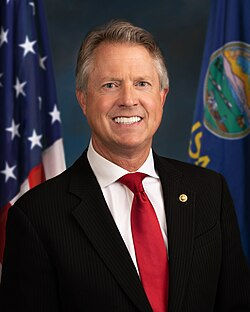
Marshall is an obstetrician-gynecologist from Great Bend who has served in the Senate since 2021. His record includes support for the One Big Beautiful Bill Act and proposals requiring documentary proof of citizenship for voter registration.
In the State Fair debate, he argued that immigrant labor had displaced jobs. Following the southwest Kansas enforcement operation, he called for ICE to coordinate with local law enforcement.

Adam Hamilton — Democrat
Hamilton is the founder and pastor of the United Methodist Church of the Resurrection. He has not held public office before.
His campaign has criticized Medicaid and food assistance reductions. In the State Fair debate, he supported agricultural visa changes to better meet employers’ year-round labor needs.

David C. Graham — Libertarian
Graham is an Overland Park attorney. In his candidate questionnaire, he supported border security and legal immigration with limits, while advocating elimination of taxpayer-funded health programs, including Medicaid and Medicare. These are his stated positions, not policies already enacted.
The September Emerson/Nexstar poll found Hamilton at 45% and Marshall at 43%, within the survey’s reported uncertainty interval. Neither candidate had a statistically clear lead in that survey.
U.S. House: Find the Race on Your Ballot
Kansas has four congressional districts. Your home address determines which district you can vote in. Do not rely only on a city or county label; consult your voter record and sample ballot. The following candidate lineups are listed for the general election.
Congressional district | Candidates |
District 1 | Tracey Mann, Republican incumbent; Lauren Reinhold, Democrat; Steven Jacob, Libertarian. |
District 2 | Derek Schmidt, Republican incumbent; Don Coover, Democrat; John Hauer, Libertarian. |
District 3 | Sharice Davids, Democratic incumbent; Eric Jenkins, Republican; Steven Hohe, Libertarian. |
District 4 | Ron Estes, Republican incumbent; Katy Tyndell, Democrat; Drew Cranmer, Libertarian. |
Attorney General: Litigation and Immigration Enforcement
The race is a rematch between Republican incumbent Kris Kobach and Democrat Chris Mann.
Kris Kobach Chris Mann
Kris Kobach (R) Chris Mann (D)
Kobach has advocated greater local participation in 287(g) agreements and supported efforts to end Kansas’ in-state tuition policy for undocumented students.
Mann is a former police officer and prosecutor. The candidates differ in their approaches to the office, but voters should examine their specific proposals rather than assume party labels answer every question.
Questions worth considering include which lawsuits candidates would pursue, how they would approach immigration-related litigation, and what oversight they favor when local agencies participate in federal enforcement.
Secretary of State: Election Administration
The candidates are Republican Pat Proctor, Democrat Jennifer Day, and Scott Morgan of United Kansas.
Pat Proctor Jennifer Day Scott Morgan
Pat Proctor (R) Jennifer Day (D) Scott Morgan (U.K.)
Proctor chairs the Kansas House Elections Committee and has supported tighter election requirements, including the proposed constitutional amendment concerning citizenship.
Day has advocated preserving the mail-ballot grace period and expanding advance voting.
Morgan has opposed requiring citizenship documents for voter registration.
Election administration involves both state and county officials. In most Kansas counties, the county clerk administers elections; Johnson, Sedgwick, Shawnee, and Wyandotte counties have election commissioners. Your county election office is the source for local voting locations and schedules.
State Treasurer and Insurance Commissioner
Steven Johnson Juan Luengo Eric Lund
Steven Johnson (R) Juan Luengo (D) Eric Lund (L)
Dan Hawkins Dinah Sykes Ric Koehn
Dan Hawkins Dinah Sykes Ric Koehn
The state treasurer candidates are Republican incumbent Steven Johnson, Democrat Juan C. Luengo, and Libertarian Eric Lund. The insurance commissioner candidates are Republican Dan Hawkins, Democrat Dinah Sykes, and Libertarian Ric Koehn.
Luengo is an insurance entrepreneur with a long history of success in the Kansas City area. Hawkins is speaker of the Kansas House, and Sykes is the Kansas Senate minority leader. Their records and proposals offer additional opportunities to evaluate candidates beyond the highest-profile races.
The Constitutional Amendment: What “Yes” and “No” Mean
The statewide amendment concerns the wording of voter qualifications in the Kansas Constitution.
A “Yes” vote would adopt language stating that no person is a qualified elector unless that person meets specified qualifications, including U.S. citizenship.
A “No” vote would leave the existing constitutional language unchanged.
Kansas already requires U.S. citizenship to vote. The amendment would make the constitutional wording more explicit; it is not a choice between allowing and prohibiting noncitizen voting under current registration rules.
The official ballot explanation says the amendment would clarify that only U.S. citizens are eligible to vote. It does not specify a new document requirement for registration.
Judges: Understanding Retention Questions
Chief Justice Eric Rosen and Justice Larkin Walsh are standing for Kansas Supreme Court retention. Voters will answer whether each should remain in office rather than choose between competing candidates.
Depending on the ballot, voters will also encounter Court of Appeals or district-court judicial questions. Kansas uses different selection systems for different courts and judicial districts.
A retention vote is distinct from a partisan legislative contest. Reviewing a judge’s professional record and available judicial evaluations can help voters understand the question they are being asked.
If you vote yes, you are voting for the judges on the ballot to stay. If you vote no, you are voting to remove the judges from the ballot.
The Legislature: Why Your District Matters

All 125 Kansas House seats are up for election. Republicans hold 88 seats; a House veto override requires 84 votes, alongside the necessary Senate support. Democrats would need a net gain of five Republican-held seats to bring Republicans below the House threshold, assuming they retain their existing seats.
This balance matters because legislative votes determine whether a governor’s veto can stand. It also affects the prospects for changes to immigration policy, health coverage, education funding, and election administration.
Most Kansas Senate seats are not regularly up for election this year, but special elections are being held in Districts 24 and 25. In Wichita’s District 25, incumbent Democrat Silas Miller faces Republican Christopher Parisho. District 24 lists Republican Scott Hill.
Your state House district is not the same as your congressional district. Check the office and district number on your sample ballot before researching candidates. You can see your candidates on KSBallot.org.
Education and Other Races Deserve Attention
State Board of Education seats in odd-numbered districts are part of the gubernatorial-year election schedule. These are separate from local school-board races.
Your ballot may also contain county, township, judicial, or local ballot questions. Because those items vary by address, a statewide guide cannot substitute for your own sample ballot.
Before voting, review every race, not only the names at the top.
How to Vote: Dates and Requirements
What | When or what to know |
Register or update your registration | By Tuesday, October 13. |
Advance voting begins | Wednesday, October 14. Mail ballots begin being mailed; in-person advance voting may begin. Check your county’s schedule. |
In-person advance voting is available in every county | By Tuesday, October 27. |
Standard deadline to apply for a mail ballot | Tuesday, October 27. File your application with your county election officer or go to KSVotes.org |
In-person advance voting ends | Noon on Monday, November 2. |
Election Day | Tuesday, November 3. Standard polling hours are 7 a.m.–7 p.m.; confirm your county’s hours and your assigned location. |
Voting in person
Kansas requires an accepted photo ID to vote in person. Examples include a driver’s license, passport, military ID, or qualifying tribal ID. Voters age 65 or older may use an expired photo ID, and certain exemptions apply. Consult official instructions if your circumstances require an exemption.
Voting by mail
The application requires a current, valid Kansas driver’s license number, Kansas nondriver ID number, or a copy of another accepted identification document.
As of October 9, the three-day mail-ballot grace period remains in effect following an appeals-court ruling. Ballots returned through USPS must be postmarked on or before November 3 and arrive within the following three days to qualify under that rule. A postage stamp alone is not a postmark. Because litigation has continued, verify current instructions with your county election office before relying on the grace period, or mail your ballot as soon as possible.
Returning a ballot early reduces the risk that delivery delays will affect its arrival.
Spanish-language materials
Finney, Ford, Grant, Haskell, Stevens, and Seward counties must provide Spanish-language election materials and oral assistance. If you vote elsewhere, ask your county election office what language services are available.
A practical checklist
Before voting:
The Secretary of State’s election information and your county election office provide official guidance on these steps.
A Ballot Connected to Everyday Life
For the mother caring for her son, public policy is not abstract. It appears in letters, eligibility decisions, and the support available at home.
Other families experience government throughlos distritos de la legislatura estatal ni los a tuition bill, a medical appointment, a food-assistance application, or the confidence they feel approaching a public office.
An election cannot resolve every administrative problem. But it gives voters a role in choosing who writes the rules, oversees institutions, and responds when families ask to be heard.
Getting informed means understanding both what candidates promise and what the offices they seek can actually do. Voting means bringing that understanding to the entire ballot.
Transparency note: Planeta Venus does not endorse candidates or parties. This guide identifies candidates and summarizes selected records and publicly stated positions relevant to our readers. Campaigns and readers may submit documented corrections to Planetavenus.online@gmail.com.

Comentarios